.png)
Yes, You Need a BOC-3 — And It's Just One Step to Get Your Trucking Authority Right
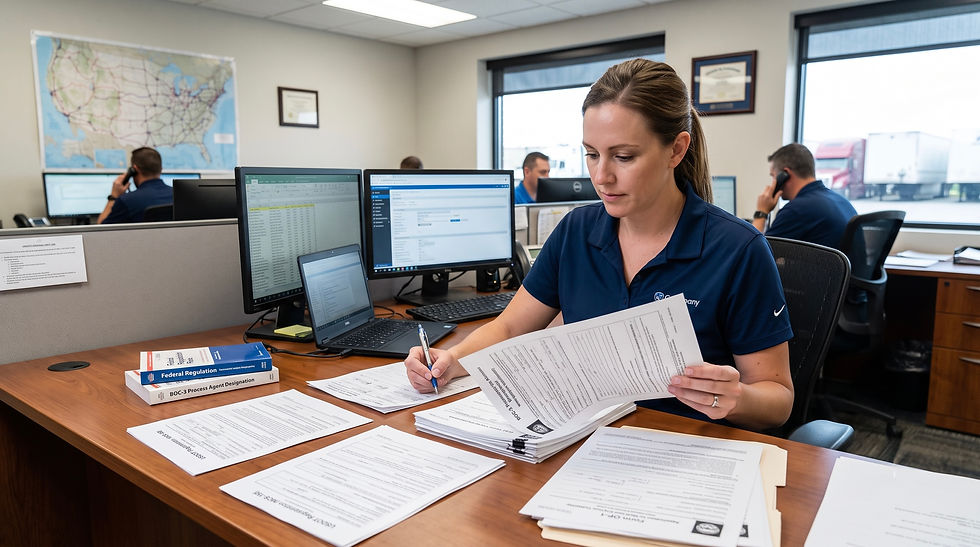
Every week, new carriers lose their FMCSA operating authority before they ever turn a wheel — not because of bad driving, but because of a missing filing. If you're figuring out how to get trucking authority, you cannot afford gaps in your compliance stack. This guide breaks down every required registration, in the order you must complete it, so you launch legal and stay legal.
Do I Really Need a BOC-3 Filing to Start Trucking?
Yes. A BOC-3 process agent designation is a federal requirement for all interstate motor carriers. FMCSA will not activate your MC authority without it. It must be filed by a registered process agent in every state where you operate before you can legally move freight.
That 44-word answer is what every new carrier should know upfront. The BOC-3 is not optional, and it is not a one-time paperwork formality — it is the legal mechanism that ensures your company can be served with court documents in any state. Miss it, and your authority sits inactive while your competitors haul loads.
The FMCSA Compliance Sequence: What to File and When
Skipping steps or filing out of order is one of the most common — and most expensive — mistakes when you start a trucking company. Here is the correct sequence, mapped to FMCSA's actual processing timelines.
Step 1: USDOT Number Registration
Your USDOT number is your federal identity. Every commercial motor vehicle operating in interstate commerce must have one before any other filing can proceed. USDOT number registration is completed through FMCSA's Unified Registration System (URS) and is typically processed within minutes online.
Required for all carriers with vehicles over 10,001 lbs. GVWR in interstate commerce
Also required for carriers transporting hazardous materials regardless of vehicle weight
The USDOT number links to your safety record, inspection history, and SMS scores — keep your information current at all times
Step 2: MC Authority Filing
Your Motor Carrier (MC) number — now issued under a Docket Number — authorizes you to operate as a for-hire carrier. MC authority filing is submitted through FMCSA's URS portal alongside or immediately after your USDOT registration. The filing fee is $300 per authority type.
Once submitted, FMCSA opens a FMCSA protest period of 10 business days. During this window, any existing carrier can formally object to your application. This is rare but real — and you cannot haul freight while the clock runs.
Step 3: BOC-3 Process Agent Filing
The BOC-3 designates a registered agent in every state to receive legal process on your behalf. This is a non-negotiable FMCSA requirement. Without a valid BOC-3 on file, your authority will never be activated, even if everything else is submitted correctly.
Must cover all 50 states plus the District of Columbia
Filed by a registered process agent company on your behalf — you cannot self-file as a single-state carrier
Must be completed and confirmed before FMCSA activates your operating authority
Requires updating any time your registered agent changes
START YOUR AUTHORITY HERE — Authority Setup files your BOC-3 directly with FMCSA, covering all required jurisdictions with zero gaps.
Commercial Trucking Insurance Requirements
FMCSA requires proof of insurance before your authority becomes active. This is not a suggestion — it is a hard gate. Your insurer files the required forms directly with FMCSA on your behalf.
Minimum Federal Insurance Filings
Form BMC-91 or BMC-91X — Primary liability. Minimum $750,000 for general freight; $1,000,000 for hazmat; $5,000,000 for certain hazmat commodities
Form BMC-34 — Required for household goods carriers to cover cargo loss
Cargo insurance is not federally mandated but is required by virtually every broker and shipper
Commercial trucking insurance requirements vary by operation type and commodity. Confirm your coverage limits with your insurer and verify that all FMCSA filings are confirmed before your planned launch date.
State-Level Compliance: UCR and IFTA
Federal filings get you operating authority. State-level registrations keep you running legally across jurisdictions. Two are required for most interstate carriers.
UCR Registration Requirements
The Unified Carrier Registration (UCR) is an annual fee paid to the state where your principal place of business is located. It covers your right to operate commercially in all 41 participating UCR states. UCR registration requirements apply to motor carriers, freight forwarders, brokers, and leasing companies operating in interstate commerce.
Annual registration opens each fall for the following calendar year
Fee is based on your fleet size (number of commercial vehicles)
Operating without UCR registration exposes you to fines at weigh stations in participating states
IFTA Account Setup
If your qualified motor vehicles travel in two or more IFTA member jurisdictions, you must register for the International Fuel Tax Agreement. IFTA account setup is handled through your base state's motor carrier services division.
Applies to vehicles with two axles and a GVWR over 26,000 lbs., or three or more axles regardless of weight
IFTA decals must be displayed on both sides of the cab
Quarterly fuel tax returns are required — missing deadlines triggers penalties and potential license revocation
Complete Trucking Authority Checklist
Use this as your pre-launch verification list. Every item must be confirmed before your first commercial dispatch.
☑ USDOT number registered and active in FMCSA's URS
☑ MC authority filed and protest period (10 business days) cleared
☑ BOC-3 process agent designation filed and confirmed by FMCSA
☑ Primary liability insurance filed via BMC-91 or BMC-91X
☑ Cargo insurance in place (required by brokers and shippers)
☑ UCR registration paid for the current calendar year
☑ IFTA account open and decals displayed (if operating interstate)
☑ ELD mandate compliance verified for your operation type
Don't Let a Missing Filing Ground Your Business
Most new carriers don't lose loads because of bad equipment — they lose them because of incomplete filings that delay authority activation for weeks. Authority Setup handles your USDOT registration, MC authority filing, BOC-3 process agent designation, and every state compliance step in the correct sequence, on your timeline.
Stop guessing. Start hauling. Let Authority Setup handle your filings today →


Comments